Sequoyah’s High School: Celebrating 10 years
A Decade of Impact
It was a brisk summer morning when they began gathering. Thirty-seven ninth graders. Fourteen tenth graders. Six faculty and a handful of staff. The Armory Center for the Arts wasn’t their planned meeting place, but no one minded. They were together in community, aware they were writing the next chapter of a story that began in 1958.
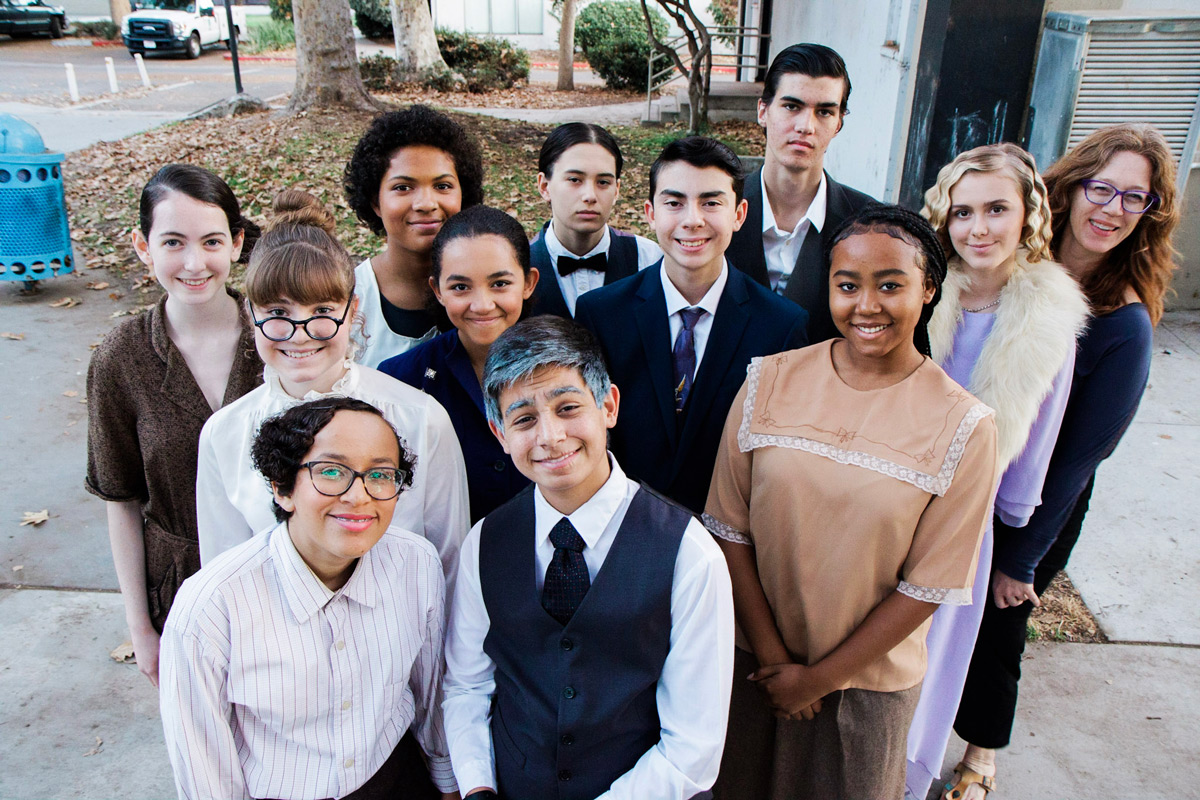
Former Head of School Josh Brody welcomed everyone and gestured to the walkway above, where a photographer waited. Some students raised their hands. Some yelled in celebration. A few shied away. But, when the shutter clicked, a milestone for Sequoyah School was saved for posterity.
August 25, 2016. Sequoyah’s high school—and its first day as a K-12 school—had arrived.
A Long Time Coming
“Sequoyah is built on the understanding that different lives, learning together, is the real education,” says Michael Barak, Sequoyah’s Chief Financial Officer and former President of the Board of Trustees. “As Board President, I understood the decision to establish a high school was about much more than adding another division. It was about determining whether we could extend the School’s founding mission and values while protecting its long-term health and integrity.”
It was not an easy decision, but it was a clear one. Sequoyah had taken mission-aligned risks before: new K–8 facilities, a more robust junior high program, larger enrollment, and more. Each now feels core to the school’s identity. The dream of adding a high school, which had been building for years, was the next logical step forward.
Alums were making the case on their own as well. “They would come back and talk about their years as a Sequoyah student for the Life after Sequoyah panel,” says Assistant Head of School and High School Director Marc Alongi. “This theme emerged; while they liked their schools, they really missed our approach in terms of owning their own education.”
It wasn’t a particular course, it was a way of learning: asking their own questions, working alongside a diverse student body, and being encouraged by teachers they really knew. “There’s a joy in learning here,” said one recent alum. “It’s easier to do hard things because of that.”
In 2012, the Board, led by Barak, committed to a K–12 Sequoyah. “We wanted to ensure our philosophy would endure beyond eighth grade and provide that same joyful pathway of the K–8 through high school to college and beyond,” he says.
The commitment came with a condition everyone understood: Sequoyah would become a K–12 institution. “It seemed natural, and developmentally appropriate, to extend our progressive education into high school classrooms, deepening intellectual inquiry, engagement, and application,” says former director of advancement Elena Phleger. In the process, great care was taken to ensure Sequoyah’s identity, mission, and commitment to socioeconomic diversity would remain unchanged.
Building it Together
Barak and Brody asked Alongi to research the right model. What followed showed Alongi in his element: drawing people in, trusting them with real ownership, and building something none of them could have built alone.
Alongi convened an Advisory Board to shape the program. Longtime K–8 art specialist Erin Trefry brought the visual arts. “If you look at the first curriculum guide, you’ll see her imprimatur there,” he says. Chelsea Confalone helped imagine a dynamic and interdisciplinary high school science curriculum. RJ Sakai ’04, a connected alum who now leads and supports stewardship and inclusive practices at Sequoyah, consulted from the start.
The group took big swings, considering a high school framed entirely around social entrepreneurship, or a fully interdisciplinary curriculum with no traditional subjects. Those formative ideas never left, but they have been evolving as the students and teachers and administrators iterate on the program over the years. They live today in the Social Innovation Program (SIP) and Talking Leaves thesis presentations; interdisciplinary thinking remains a key program objective.
The next question was where. Sites from the Southwest Museum to the former Ambassador College were considered; some were too expensive, others needed major renovation. Then the Neighborhood Church, whose original Pasadena property is now Sequoyah’s K–8 campus, asked whether the school needed space.
“The timing couldn’t have been more serendipitous,” says Alongi.
With all the key pieces in place, the Board approved the establishment of the high school. In January 2015, Sequoyah voted to lease part of the church’s campus near the Gamble House beginning that July.
The team now had one year to enroll students, hire faculty, and refine a curriculum.
Sequoyah families opened their homes for Q&A sessions. Patricia Han, whose children are K–8 alums, led admissions and, as Alongi jokes, served as ad hoc athletic director as well, calling gyms and finding coaches. “It was a true startup!” Han recalls. “We would celebrate each time a family enrolled.”
There were anxious months. “There was a moment where I thought we were going to have only 20 kids,” Alongi says. By August 2016, however, there were 51.
The founding faculty arrived the way the ideas did: through relationships and conversation. Confalone and Arden Thomas spent the year building curriculum before becoming the founding biology and theater/humanities teachers. Thomas wanted a theater program “intentional about both artistic excellence and a sense of belonging.”
For music, Alongi asked Daniel French of the East L.A. band Las Cafeteras, “Who do you know?” French suggested Ben Ede. “I was intrigued to find a place willing to put real effort behind the desire to create a diverse campus,” Ede says. A decade of Gryphon Ensemble and Studio Band has followed.
Alia Kate joined as the first Director of Social Innovation and Field Studies, connecting students with organizations across Los Angeles. SIP remains a defining part of the high school, carried forward by Sakai and current Director of Social Innovation Joel Murillo.
The Ride Home
One piece was still missing. Educational reformer and progressive educator Ted Sizer argued a diploma should be earned by exhibition, not just seat time. The faculty wanted that: a portfolio each student would build and defend. So they packed into a school van and drove to Wildwood School to see how it could be done.
“It’s a good model, one we thought we wanted to do,” Alongi says. But on the drive back, the conversation turned. What they had seen was strong, but it wasn’t quite Sequoyah. Instead of asking students to present everything they had learned, what if each student chose one subject and went deep?
By the time the van got back to Pasadena, the idea had shape. “There was such energy and consensus around it,” Alongi says. They named it Talking Leaves, an homage to Sequoyah himself. Today Talking Leaves is a multiday event held every fall and spring. Students present college-level work on a topic that speaks to them before taking live questions from faculty, peers, and outside guests.
Selina Yang ’20, now a Ph.D. student in astrophysics at Cornell, recently learned what her candidacy exam will look like. “It’s exactly the same format as Talking Leaves,” she says. “You write a paper, you go talk to a panel, they ask you really hard questions. But I feel so prepared because I’ve been doing this since high school.”
The First 10 Years
“We were a tiny school, experimenting with all kinds of ideas,” Thomas says. “Our students were part of building the school culture right alongside us. There was a sense that anything was possible.”
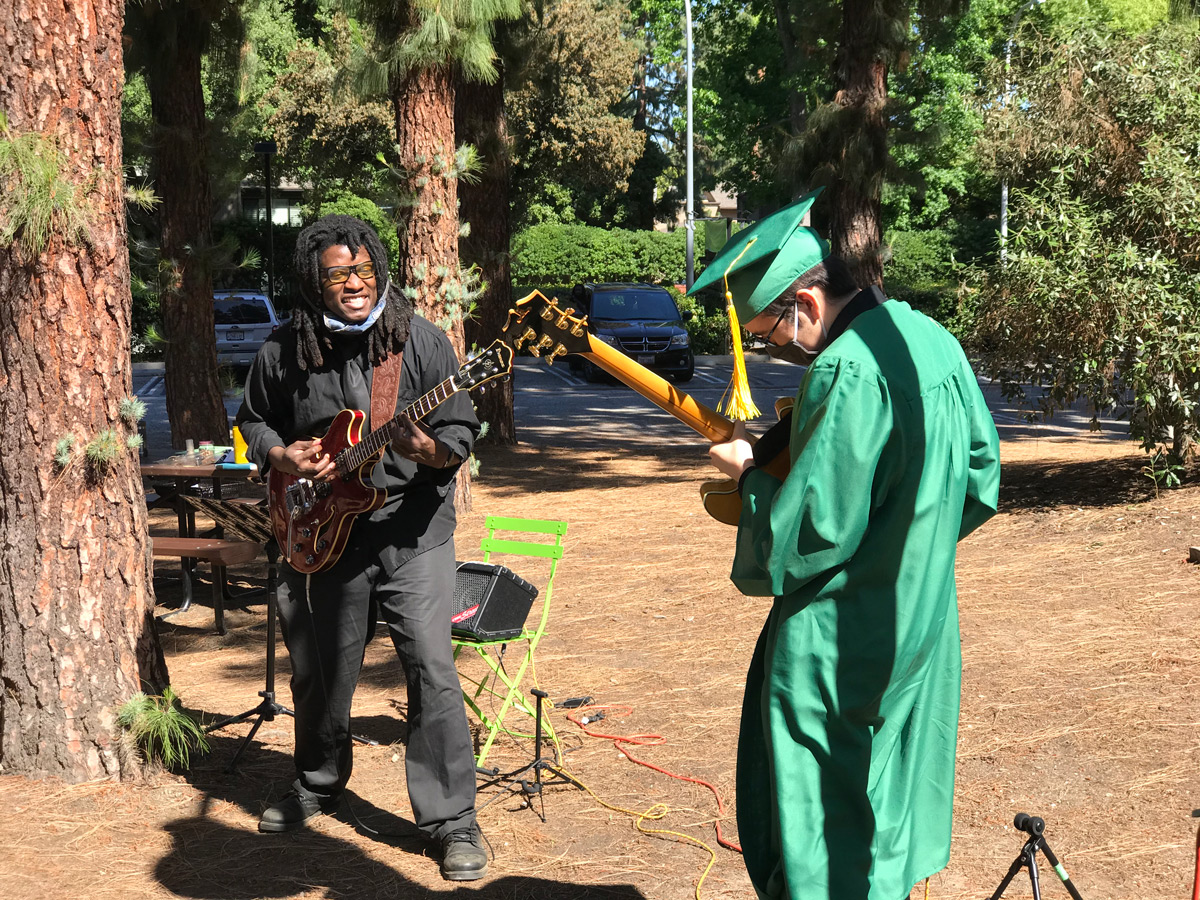
Then COVID hit. Social distancing. Zoom classrooms with resilient students celebrating one another and practicing activism at a distance. The Class of 2020 came to campus one at a time to receive their diplomas, and some stayed for socially distanced jam sessions with Ben Ede. A school built on relationships, it turned out, could hold together even when its people couldn’t share a room. When the community returned, it kept growing. New teachers brought new voices and ideas to campus, and incredible staff like Director of College Counseling Amy Abrams arrived to help students prepare for life after high school.
Today, the high school is home to more than 200 students and faculty, and eight graduating classes are at work in the world. And the school keeps evolving. This year’s theme, Perspective in Practice, asks students to make the most of a diverse community by building a skill in short supply: staying in productive conversation with someone who sees the world differently. A cohort of trained student leaders, a “dialogue gym” for practicing conflict management, and visiting experts in intergroup dialogue are part of the work.
“Like our founders,” says Head of School Rebecca Hong, “the people who built this high school had a vision. Today’s high school team carries it forward and sharpens it every day.”
And Still Building
When asked, Alongi doesn’t describe a finished school. He talks about seeking a home for theater, more room for athletics, greater space for STEM and SIP, and an eventual place where the whole K–12 school can come together. “The vision is still evolving,” he says. “The coherence is there, and it takes time to build.” Brody, when looking back at his tenure, had this coherence in mind. “The culture,” he said, “is what I’m most proud of. There is something you feel when you come onto this campus. And that culture permeates from K through 12.”
“I feel enormous pride in the decision we made back then,” adds Barak. “And even more in the community that turned that vision into reality.”
In 1958, no one could have pictured the world today’s graduates are entering, where software drafts essays, summarizes readings, and rivals the world’s best mathematicians in minutes. Yet the values Sequoyah committed to at its founding describe exactly what this world needs: curiosity that belongs to the student, sound judgment, the ability to learn alongside people whose lives differ from your own, and the power to shape a community. No machine can replace those capacities. Sequoyah exists to develop and amplify them.
The Sequoyah faculty and staff in that Armory photograph saw what students needed and built it. “I’m in awe of what they did,” says Hong. “Every generation here has asked what students need next. The answers change. The values underneath them don’t.”
Those values endure, she says, because they were never only about the individual. “Most of the world treats individual achievement and care for others as competing goals,” Hong adds. “We treat them as one: each student becomes more fully themselves by learning that their growth is bound up with everyone else’s. That’s how you raise people who think for themselves, live well with others, and can hold a democracy together. It’s what Sequoyah’s progressive education was always meant to do.”
She smiles. “It amazes me. We’ve been evolving since 1958, and we’ve never lost sight of why.”
Top: Day One of Sequoyah’s high school adventure began at the Armory Center for the Arts on August 25, 2016.
Above: Music faculty Ben Ede jams with Gabriel Robles ’20 at the socially distanced Class of 2020 graduation.
Below: Theater and Performing Arts Chair Arden Thomas with the 2019 cast of Radium Girls.