
Visual and Performing Arts
What Remains, What Begins
On a spring afternoon at Pasadena’s Armory Center for the Arts, a small crowd climbed the stairs to the mezzanine gallery, past photographs with burned edges, portraits paired with handwritten interview transcripts, and a family caught mid-gesture in an orange grove. The occasion was both artist talk and homecoming; in 2016, high school students met here for the first time. A decade later, the building hosted the school’s tenth-anniversary exhibition of student and alum art, called One Day I Finally Knew What I Had to Do, and Began, a title borrowed from a line in American poet Mary Oliver’s poem “The Journey.” The show filled the Armory’s upstairs gallery through the end of May; in its final weeks, seniors Dashell Wasson and Penny Martinez joined alum Dahlia Kim Levy ‘23 to talk about the work on the walls and the decade that preceded it.
A Founding Address, Revisited
For Sequoyah, the Armory has long functioned as a second home. The high school opened as an extension of a K-8 program running since 1958, built on a progressive philosophy that prizes experiential learning, student agency, and, in the words of the school’s mission statement, an education that “challenges the mind, nurtures the heart, and celebrates human dignity.” The ethos balances challenge, nurture, and celebration—and that vision found an early ally in an arts nonprofit devoted to similar ends. Armory staff opened the talk by describing their mission to nurture community and young people through art-making that advances equity and social justice, and to help imagine a community shaped by many voices. This alignment brought Sequoyah’s high schoolers through the Armory’s doors, and the exhibition and talk honored that alliance.
Viviana Palacio, who chairs Sequoyah’s visual arts program, framed the show around Oliver’s line, describing the arc every young artist travels: through uncertainty, toward clarity, and into the slow, unglamorous work of beginning. She turned first to Penny and asked when she had known what she had to do, and began.
Family as First Material
Penny’s series, Soy Una Mosca, grew out of a short story written by her older sister, Lucy, who also modelled for the photographs. “My family is my muse,” Martinez said. Her sister’s writing sparked a series that weaves text into the image, while family supplies its subjects and setting. The story follows a Hispanic narrator navigating a limited fluency in Spanish. “This experience that this character has, and her story as someone who’s Hispanic and doesn’t speak the language, really resonated with me so deeply,” she said.
The photographs were shot at the family home where Penny’s mother and grandmother had grown up. An orange tree recurs through the frames, tied to a family ritual of harvest and sharing, while braided hair links three generations of women. Many subjects, artist included, appear with their backs to the camera, a choice bound up with the work’s tension around belonging.
“I’m part Mexican, and so I’m mixed. I’m Filipino and I’m Mexican,” Penny said. “This feeling of feeling sort of torn between the two… I wanted to impart the feelings that I feel, disconnect with my own culture at times, and make the viewer feel that.”
The title carries the same charge. Soy Una Mosca, or “I am a fly,” comes from a scene in the story in which a grandmother tells her granddaughter that flies avoid a closed mouth, a rebuke for talking too much in the kitchen. For Martinez (right), the fly became a symbol for someone learning to interpret a language and culture she loves, leaning on body language and gesture to fill in for words she is still acquiring. Asked what surprised her most, she described her family’s relationship to its heritage: her grandmother’s generation taught to suppress it, her mother still working to learn the language she wanted, herself now reaching for it. “We’re all still trying to deal with it,” she said, “and trying to heal our relationship with our own culture in a country that is actively deporting people for doing so.”
Ashes and What Remains
Dashell’s series Remains began in the aftermath of the Eaton Fire. Wasson recalled walking through the burn zone and noticing chimneys still standing where houses once had. “I felt like they represented gravestones of the houses that were there previously,” he said. That image led to his project, for which Dashell returned to the wreckage of his family’s home to locate the physical sites of specific memories (a Christmas, the day his father built the pool, and others) and photographed them among the rubble. He printed the images on fiber paper meant to evoke memory’s texture, pairing black-and-white photographs of the original moments with burned-edged color prints of the same locations today. “It poses the question to the viewer: what literally remains, and what remains in my memory,” he said, and added, with some amusement, that burning the edges by hand over the kitchen sink took hours and left him smelling of smoke for days.
A second piece, The Phoenix, turns the same fire into a story of repair. Dashell and his father had spent nearly two years estranged before the fire destroyed the family home, and working through the wreckage together brought them back into contact. The image moves from a darkened center, representing the period before the fire, outward into lighter tones that suggest hope.
“There were better days, right?” Dashell asked the crowd. “We may have had a couple of bad times, but there were better days. It motivated me to want to heal the relationship more.”
Sustaining a Practice After Graduation
Dahlia, a photographer studying at Parsons School of Design, offered the clearest picture of what a Sequoyah arts education can grow into over time. She got her first camera the week before COVID-19 closed the school, and began photographing the people closest to her during forced isolation. “I started to kind of just capture that as my own defense mechanism at the moment,” she said. In capture, the camera’s action becomes an impulse to hold on.
What began as COVID Girls—a senior project rooted in quarantine and Zoom classes—has since grown into an ongoing body of work called COVID Gen, built around photographic portraits paired with recorded interviews. Dahlia traces her turn toward text and oral history to Nan Goldin’s The Ballad of Sexual Dependency and Abigail Heyman’s Growing Up Female. That influence shaped her deliberately informal interview format.
“We’re used to texting, we’re used to abbreviations,” she said. “Our attention spans are short.” The informality preserves a generational cadence. Watching her subjects—many of them close friends from adolescence—move through college has shown her how differently isolation shaped each of them, and she describes these reunions as “a really fascinating way to get to know new people in my life while also really reflecting on these friendships that I was carrying out at that age.”
Kim Levy shoots on medium-format film, a deliberately slow choice within a fast-moving digital culture, and one sustained through real labor years past its original assignment.
“When I’m sitting with these photos, like, it’s a pain, but I am going to drop them off at the lab,” she said. “I’m scanning them by hand. I’m editing them by hand and then I’m printing them by hand.” The repetition of ‘by hand’ makes persistence audible in the sentence.
Asked how photography helps her sit with something as heavy as a generational rupture, she described the medium’s particular pull: “Being behind the lens and being separated from your subjects and from what you’re working on kind of allows you to assess what’s in front of you in a way that can give you a real sense of control.”
The most striking moment in Kim Levy’s remarks came from a discovery about her own family. Her practice closely mirrors her mother’s ongoing oral-history project documenting Koreatown, a resemblance that became clear only after her younger brother pointed it out. “He just looks at me and he’s like, ‘So you’re just doing her program,’” Kim Levy joked. The comment makes artistic inheritance unceremonious. Creative habits can travel between generations quietly, surfacing only much later. “I think it’s all become quite intertwined,” she said.
A Decade in the Same Room
The conversation at the Armory traced a throughline from Sequoyah’s founding philosophy to the work hanging on its walls last spring. A school built around experiential learning, student agency, and social justice has raised three young artists who turned personal rupture, displacement, and isolation into disciplined, sustained bodies of work. Their seriousness lies in form as well as subject: the orange tree, the burned edge, the slow labor of film and recorded voice.
The Armory remains a place where Sequoyah students exhibit and are recognized as artists in a public gallery. The partnership has produced a pattern: young people given a real audience, a real wall, and real stakes, learning early that art can hold grief, memory, reconciliation, and beauty. Kim Levy’s presence at the talk, an alum still building on work she began as a senior, offered evidence that what Sequoyah and the Armory began together in 2016 continues to grow past graduation.
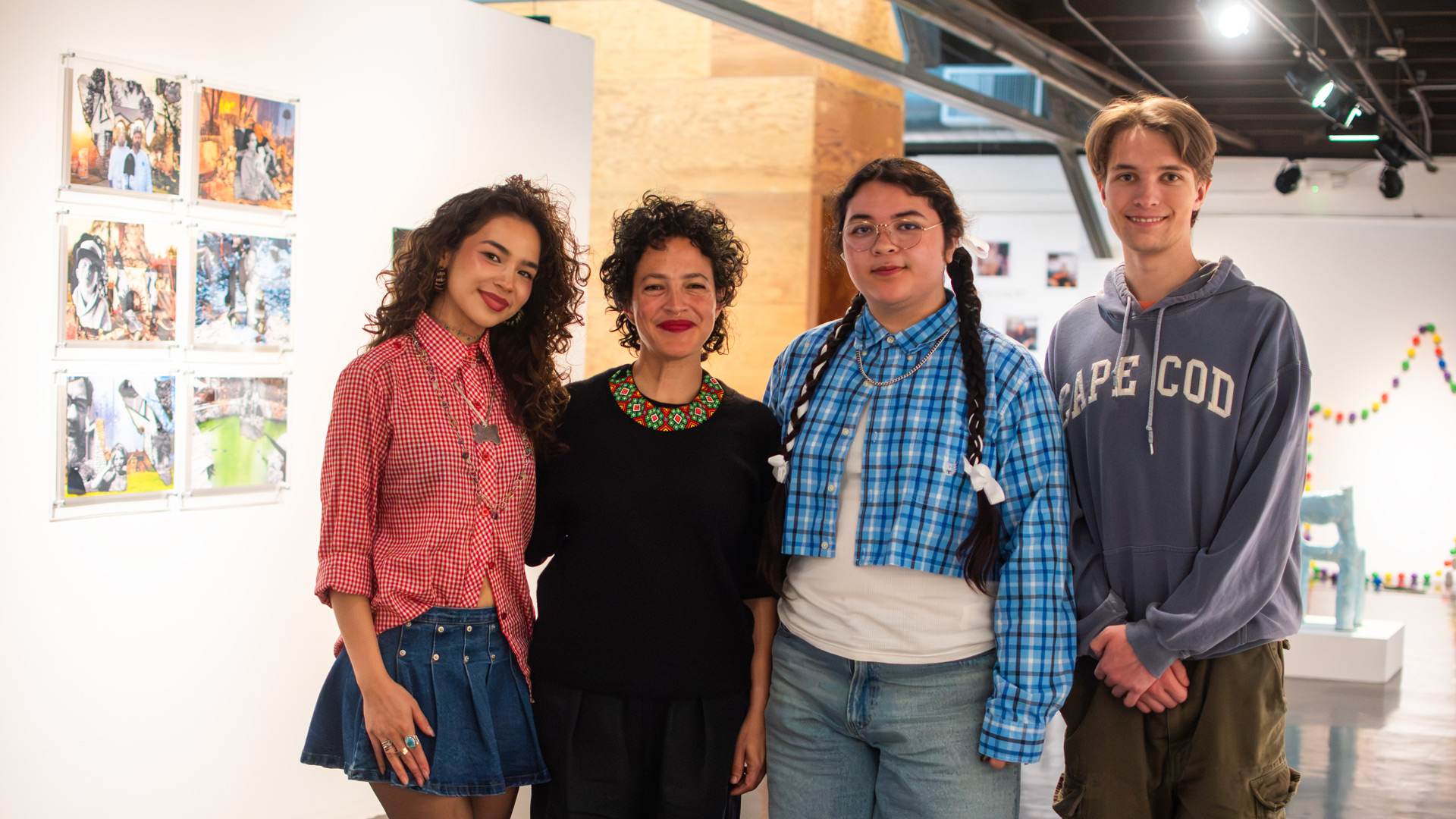
Above (l-r): Dahlia Kim Levy ‘23, Viviana Palacio, Penny Martinez ‘26, and Dashell Wasson ‘26 at the Armory Center for the Arts in Pasadena.